Bad at Journaling
3-minute read
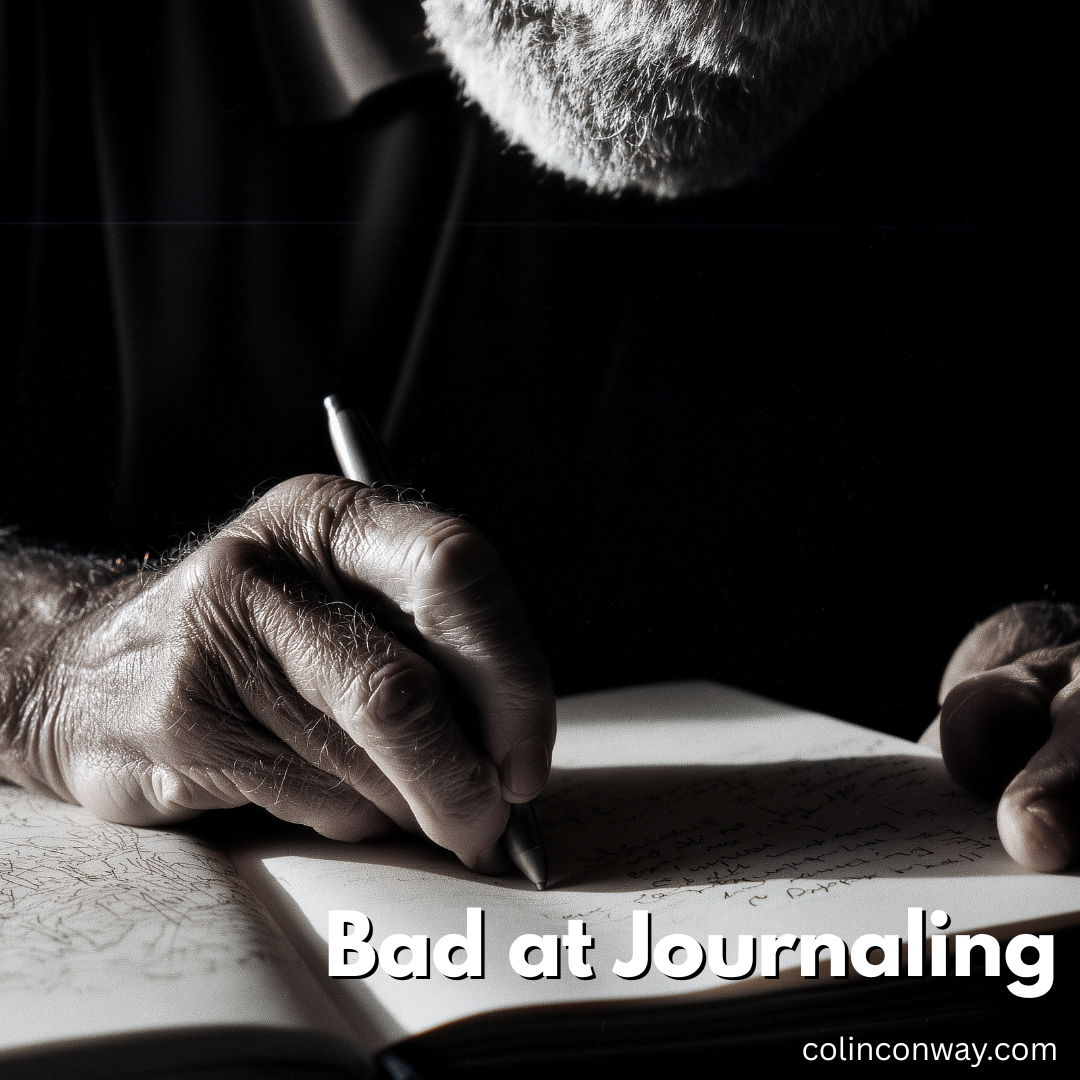
Do you share your thoughts in a journal or a diary?
I have a friend who writes in his journal daily, right before he goes to bed. It’s an admirable habit and one I’ve tried unsuccessfully to start many times. I would journal right before bed or first thing in the morning. I’d jot down some thoughts or concerns, then put the journal away.
Some journaling attempts only took a few days. Others lasted a couple of weeks before I quit. The only journal I kept successfully for a full year was the one I wrote for my girlfriend. Every evening, I spent a few minutes sharing how I appreciated her or some quality she had. It was a great experience for me and a gift I could tell she appreciated completely.
However, the next journal I tried was for me and it petered out after a week or so.
I’ve had nice journals in leatherbound covers. I’ve had some in the old black and white composition books we used for school. I found a few of these failed journals while cleaning my office recently.
Here’s a fun bit of trivia. It’s easier to write in a clean office. A messy workplace is visually distracting and creates a level of anxiety when trying to apply order to a world of my own creating. Maybe that’s just me. Anyway, I was cleaning my office the other day, dusting off my knickknacks and rearranging my books (are your books organized by genre, author name, or both?) when my 509 Crime Stories caught my attention. My gaze drifted over my other series and that’s when I realized I’d been journaling all along, just hiding it inside my various characters.
Every story has a piece of me in it. It could be large or small, but a piece is always there (sometimes more than one). In the introduction to Cutler’s Cases, I mentioned how I first came to writing through short stories. Those tales were filled with anger because I was going through a divorce (my first). Maybe I should’ve journaled back then, but I created characters and thrust them into bad situations. Their suffering made me feel better.
Yeesh, that last bit sounds like something a psycho would say. I’ll save it for a new story.
I dealt with the emotions surrounding my father’s battle with dementia in The Only Death that Matters. Every John Cutler Mystery bears the concerns I have about being a better man and how I sometimes engage in self-sabotaging behavior (often while I know I’m doing exactly that). Detective Andrew Parker made a mistake by climbing the department ladder and is worried about making a change because of how he’ll look weak by stepping down. I’ve felt that exact thing a couple of times in my life.
I’ve told stories about my loves, my losses, and my regrets through action and character arcs.
A therapist I went to during my time on the police department once said I had “an underlying sadness.” She was smart and attentive and cut me to the bone with that statement. It’s been more than two decades since she uttered those words and I’m still trying to outrun them. Dallas Nash is the embodiment of her sentiment. Maybe that’s why I love him so much.
I’m sure other writers include their fears or hopes inside their stories. Instead of creative writing, maybe we should call it creative journaling or creative therapy. Oh, I like that last one—creative therapy.
I tossed those old journals I rediscovered during my recent office cleaning. There was no reason to keep them. Nothing I wrote in a journal ever evoked the feeling I get when rereading a passage about Nash, Cutler, or Parker. Maybe I wasn’t as honest in my journaling as I am in my storytelling. Hopefully, you will feel that when you read the stories.
Creative therapy. Yeah, I’m going to hold on to that one.
This post originally appeared as a VIP Newsletter.